Wednesday, March 9, 2011

The Author

http://upload.wikimedia.org/wikipedia/commons/5/5a/Ibsen_photography.jpg

Knowing about the author of the play is also very important. Henrik Ibsen (1828 – 1906), after publishing his first play in 1850, was appointed resident dramatist and stage manager at the newly created Norwegian National Theatre in Bergen in 1851. By 1857 he had assisted in staging 145 plays, and had written seven of his own. Between 1857 and 1862, he worked at the Norwegian Theatre in Christiania (Now Oslo), and after 1864 he lived abroad until 1891.

Ibsen wrote twenty-five plays. Most of the early works are verse-dramas about the Scandinavian past. These include Lady Inger of Ostraat (1855), The Viking at Heelgeland (1858), and The Pretenders (1864). The most important early works, however, are Brand (1866) and Peer Gynt contrasts sharply with Brand, for its protagonist is a man who avoids issues by skirting them. A skillful blending of fantasy and reality, Peer Gynt was interpreted by many as a satire on the Norwegian character.

In the 1870s Ibsen made a sharp break with his past when he announced his intention of abandoning verse because it was unsuited to creating an illusion of reality. The future direction of his work first became apparent with Pillars of Society (1877), but it was with A Doll’s House (1879), Ghosts (1881), and An Enemy of the People (1882) that Ibsen established his reputation as a radical thinker. Above all, it was a Doll’s House and Ghosts that shocked conservative readers and served as a rallying point for supporters of a drama of ideas. Unlike Dumas fils and Augier, who also wrote about controversial subjects, Ibsen did not resolve his plays in ways that confirmed received ideology. Rather, he made ideology the cause of problems and suggested that need to change it.


History of Theatre, Oscar G. Brockett, Franklin J. Hildy

http://danliterature.files.wordpress.com/2010/06/henrik-ibsen1.jpg

Getting Started

Once the play is picked, getting the script and breaking it down is the next step in getting a production under way. Knowing who the characters are, how many there are, how old they are, etc. are all valuable information in which a dramaturgs should know.

http://academics.triton.edu/uc/files/dollshse.html

My Early 19th Century Play

My early 19th century theatre play pick was A Doll’s House written by the Norwegian playwright Henrik Ibsen ( 1828 – 1906 ), dramatized the life of the writer Laura Petersen Kieler . Kieler forged documents to save her sick husband, but he demanded a legal separation, took custody of the children, and had her committed to an asylum. In the play, Ibsen's heroine, Nora , leaves her husband and children, goes in search of an education, and embodies the struggle for subjective freedom associated with the First Wave of the European women's movement.

http://thefiendish.com/wp-content/uploads/2009/05/ibsen-dolls-house.jpg

The shock when Nora slammed shut her doll's house door reverberated throughout Europe and around the world. After the first production in Copenhagen in 1879 , Ibsen agreed to write an alternative ending for Germany: Nora's husband forces her to look at their sleeping children, and she stays. Although bowdlerized versions with happy endings appeared in America (The Child Wife, 1882 ) and Britain (The Breaking of a Butterfly, 1884 ), the original ending was championed by activists including the Russian Bolshevik Alexandra Kollontai , the American anarch‐communist Emma Goldman , and the British Socialist Eleanor Marx .

A Doll's House became the most performed play on the planet in the first half of the twentieth century as women dealt with the global changes associated with modernity. In 1911 , in the same month that the play opened in Tokyo, the feminist magazine Seito (Bluestocking) appeared and was derisively nicknamed in the popular media a nursery school for the education of Japanese Noras; in 1924 , Beijing warlords banned the play for undermining the moral integrity of China. A 1940s Argentine film version, framed as flashback, ends with an emancipated Nora returning home (directed by Ernesto Arancibia , 1943 ); a 1990s film version from the Islamic Republic of Iran has Sara/Nora leaving her husband and defying custody laws by taking her daughter (directed by Dariush Mehrjui , 1994 ). In the latest Berlin Schaubühne production, Nora shoots her husband, and he dies floating in a giant aquarium (directed by Thomas Ostermeier , 2003 ). Nora's fate has provoked rewritings, critical speculations, and dramatic sequels for more than a century. The most fantastical, written by Tanaka Chigaku in 1924 , has Nora training as a pilot in Paris, promoting world peace by flying from Italy to East Asia, and reuniting with her pacifist husband.

Extraordinary women have acted Nora; they have challenged the arts industry as directors and producers and have rocked society as political rebels. From 1889 to 1891 the English Ibsenite actress‐manager Janet Achurch promoted and performed the play throughout Britain, Australia, and New Zealand. In 1907 / 1908 , two celebrated Russians played Nora in New York: Vera Kommisarzhevsky, the originator of the Moscow symbolist theater, and Alla Nazimova, the flamboyant bisexual Hollywood star who in 1921 made one of the seven silent film versions of the play. Fifty years later, Hollywood cast Jane Fonda as Nora, no doubt because of her infamy as Hanoi Jane, the anti–Vietnam War activist (directed by Joseph Losey , 1973 ). The actor and director Mai Zetterling and the actor and UNICEF ambassador Liv Ullman were both famous Noras, but the most notorious of all was Jiang Qing (Lan Ping), the wife of Chairman Mao Zedong and member of the Gang of Four, who played the role in 1935 —a year known in Shanghai theater as the “Year of Nora.”

http://www.oxfordreference.com/views/ENTRY.html?entry=t248.e258&srn=3&ssid=1100691863#FIRSTHIT

http://thefiendish.com/wp-content/uploads/2009/05/ibsen-dolls-house.jpg

Tuesday, December 7, 2010

Medieval Props

Medieval Props


Last but not least, props.  If you've gone far enough to research the play, the author of the play, the specific time period in which that play was written, dialects, character analysis, stage setting, clothing attire, might as well finish strong and cap it off with the correct objects/props that were possibly used back in that time.  Even a small thing such as the way the wheel barrel is created can throw the whole play off if there was a modern wheel barrel used.

http://chair.pubks.com/Medieval-Props


http://www.partyprops.com/medievalprops.htm


Medieval Clothing

There certainly were other people besides knights who wore regular clothes, not just heavy metal armor and shields. Just like during any other period of time in history medieval clothing came in a variety of styles which were based mainly on class issues. Whether you dressed in coarse abrasive materials that might rub your skin raw or in delicately sewn smooth silks depended solely on how much money you had. The wealthy dressed in finery while the peasants were lucky to have anything to wear at all. They were graceful for whatever clothing they had and the material mattered not to them. What class you belonged to was the deciding factor in how you dressed.


Woman in a blue dress weaving cloth on a loom


Woman in elegant dress talking


http://lexisproject.arts.manchester.ac.uk/gallery/clothing.html

Medieval armor and Weapons


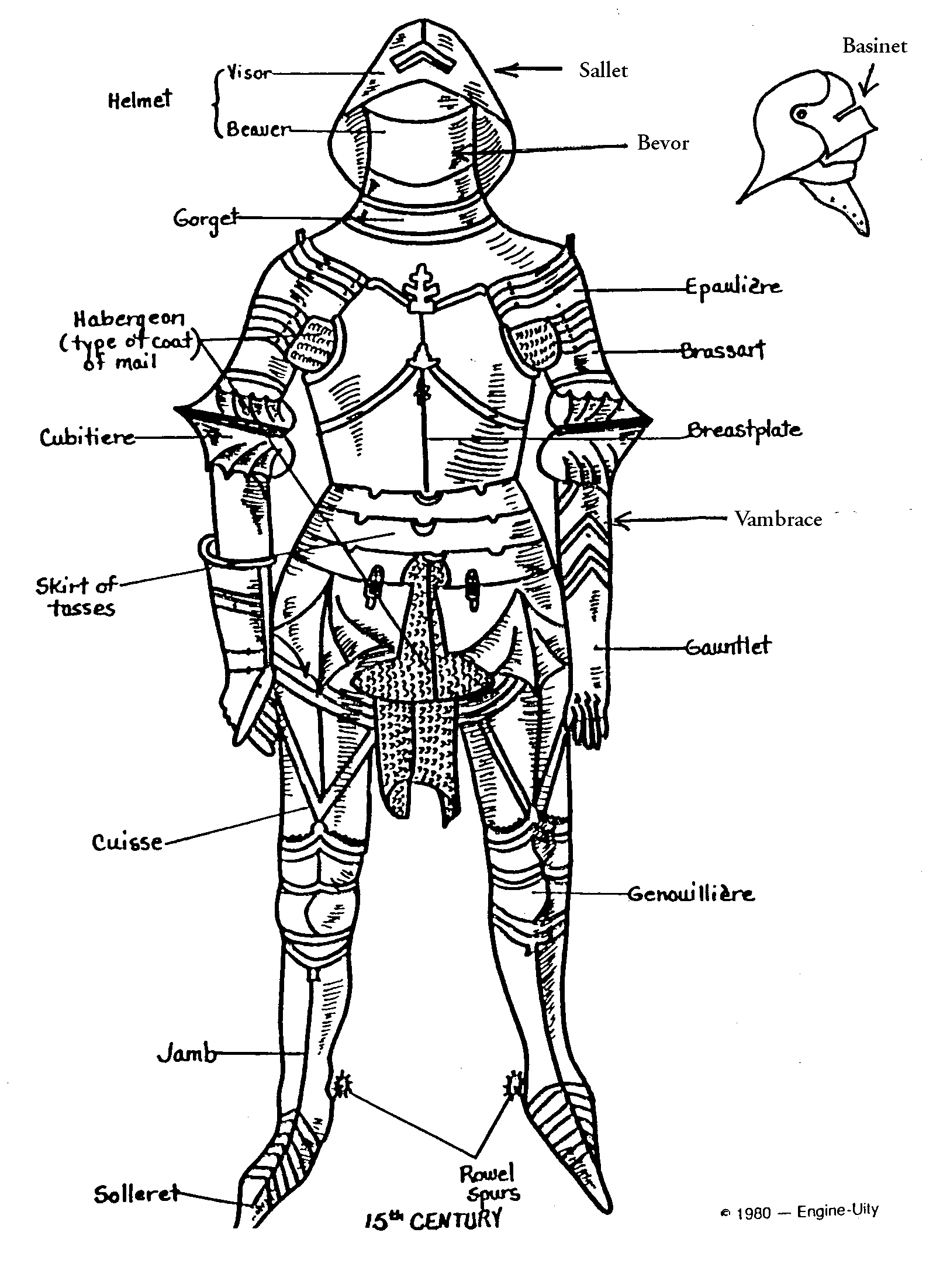
A knight was armed and armored to the teeth. He had so much armor and weapons that he depended on his squire to keep his armor and weapons clean and in good working condition. At first the armor was made of small metal rings called chain mail. A knight wore a linen shirt and a pair of pants as well as heavy woolen pads underneath the metal-ringed tunic. A suit of chain mail could have more than 200,000 rings. However, chain mail was heavy, uncomfortable, and difficult to move in. As time passed, knights covered their bodies with plates of metal. Plates covered their chests, back, arms, and legs. A bucket like helmet protected the knight’s head and had a hinged metal visor to cover his face. Suits of armor were hot, uncomfortable, and heavy to wear. A suit of armor weighed between forty and sixty pounds. Some knights even protected their horses in armor.

A knight also needed a shield to hold in front of himself during battle. Shields were made of either wood or metal. Knights decorated their shields with their family emblem or crest and the family motto.

A knight’s weapon was his sword, which was about thirty-two pounds. It was worn on his left side in a case fastened around his waist. A knife was worn on the knight’s right side. Knights used other weapons in combat as well. A lance was a long spear used in jousts. Metal axes, battle hammers, and maces were also used to defeat the enemy.


http://library.thinkquest.org/10949/fief/medknight.html

Knight Training

Combat/sword training is something that needs to be learned from a professional.  Anything that required physical combat involves personal safety, injuries and such could happen if you try to learn combat/sword training on your own. As I've mentioned before, during the medieval times a knight needed to be wealthy to become such a status, but not only that you had to be physically fit as well.  Tests were given to people who wanted to become knights.  Wearing all those heavy armory was not a a walk in the park, so these tests were given for this exact reason.  These videos will show some of the training and information on what it takes to become a skilled combat/sword fighter and the practices that comes with it.


knights.JPG